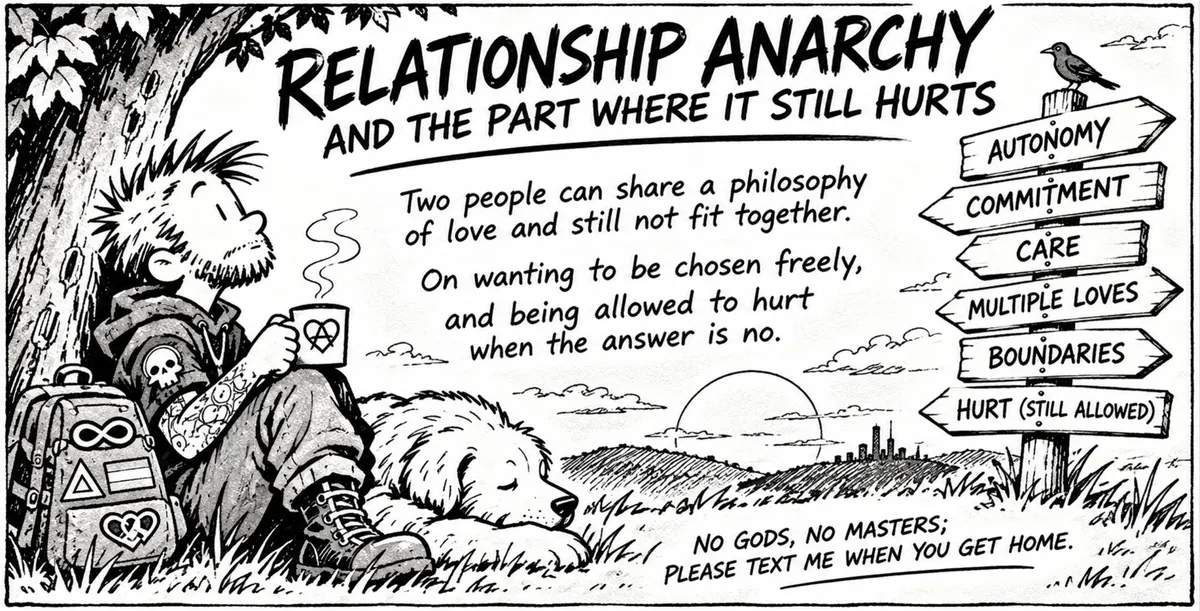
Relationship Anarchy and the Part Where It Still Hurts
no gods, no masters; please text me when you get home.
there is an idea in lola phoenix's "relationship anarchy for newbies" that i keep coming back to: two people can share the philosophy and still want relationships that don't fit together.
i understand that intellectually.
the rest of me would like to speak to a manager.
 i have been married. i have been divorced. i have loved more than one person. somewhere in all of that i keep finding the same question: if i can understand you, and you can understand me, why can't we make this work?
because understanding someone can tell you exactly why it won't.
i dislike that answer. it leaves me with very little to troubleshoot.
relationship anarchy asks why romance automatically outranks friendship, and why a certain kind of closeness supposedly requires a certain next step. having several partners doesn't settle any of that. in andie nordgren's manifesto, autonomy sits next to explicit communication and commitments people design together; there is room in it for building a life, raising children, owning a house. rejecting a prescribed relationship doesn't require rejecting a dependable one.
that matters to me. i want relationships we actually choose, including the boring parts where we say what we can offer and then try to do it.
i also want to be wanted with some specificity. i want to know there is a place for me in someone's life that they made on purpose; that my presence matters beyond whether i am convenient, available, or particularly good at understanding why somebody else is having a difficult time.
can i want that without quietly turning love into a property dispute?
i think so. but i have to leave room for an answer i don't like. someone can hear what i need, understand it, care about me, and still decline. my freedom includes asking. theirs includes refusing. mine also includes deciding that what remains isn't enough.
the fine print my brain keeps looking for
i grew up paying attention to the emotional weather in a room. a slammed door could carry information nobody was going to explain.
now i want people to tell me what they mean. i'm autistic; unspoken expectations can feel like being graded on instructions i never received. i don't need every future feeling documented. i would appreciate knowing which conversation we're having.
does "i need space" mean tonight, several weeks, or that something has changed between us? did we make an agreement, or did i hear a hope and build a small civilization around it?
this is part of why relationship anarchy appeals to me: we get to discuss the assumptions. but i can also make clarification do a job it cannot do. if i ask enough questions, can i eliminate the possibility of being surprised? can the right agreement guarantee that nobody changes their mind?
no. apparently human beings remain human beings even after a productive meeting.
phoenix's episode makes a distinction i need to remember when uncertainty starts feeling like evidence: someone resisting the big relationship conversation may be overwhelmed by the size of it. from the outside that looks a lot like not caring. some answers take time.
i can ask for clarity about what someone knows now. i cannot require them to know the rest of their life because not knowing makes me afraid.
when i start disappearing into usefulness
i know what it feels like to become infrastructure in a relationship. useful. dependable. expected to keep functioning. there is a particular loneliness in wondering whether the place you occupy is a place where you are loved or a job you have become very good at doing.
i like caring for people, and i want to keep that. i also want room for the version of me who has nothing useful to offer that evening. just me, tired, hoping my company is still wanted.
am i hoping that being needed will spare me the uncertainty of being chosen?
a philosophy about freedom also doesn't answer who has money, whose schedule runs the calendar, or who can afford to say no. calling everyone equal doesn't make those differences disappear. so the practical question: whose needs can change the arrangement, and who keeps absorbing the inconvenience?
and, less comfortably: when have i been the person expecting someone else to absorb mine?
compatibility is where my argument runs out
i know the impulse to defend my character while trying to save a relationship. i can explain what i meant, what i feared, and why the sequence of events looks different from inside my head. sometimes that helps. but having a complicated internal life does not complete an apology, and neither does describing the mistake with impressive precision. i can produce a very thorough incident report; someone still has to fix the fucking thing.
"i love you" tells someone something important. it doesn't tell them whether i can show up on thursday.
the possibility i struggle with is that nobody needs to be defeated for a relationship to be unworkable.
someone may want a shared home. someone else may need to live alone. one person may want planned time; another may only be able to offer occasional contact. affection can exist on both sides of an arrangement that leaves one person persistently lonely.
i can understand every reason for the offer and still be unable to live on it.
this is where i have to be careful with my talent for questioning things. a conversation can reveal a misunderstanding. it can also become an attempt to exhaust an answer until it changes. how many times can i ask someone to reconsider before my curiosity becomes pressure?
compromise can help. sometimes, though, staying requires someone to keep surrendering something they know they need. i don't want to turn that surrender into proof of love.
and hurt, by itself, can't tell me which situation i'm in. i can be devastated by a choice somebody was entitled to make. i can also be hurt because an agreement was broken. the intensity of the feeling doesn't do that sorting for me. incompatibility can't become my word for skipping an apology; an apology can't become a reason i have to stay.
nobody gets a medal for needing less
i don't want polyamory to become another place where i perform being easier to love.
i can imagine becoming very fluent in freedom while editing every inconvenient need out of the conversation. look how relaxed i am. look how little reassurance i require. please admire the lack of demands while i quietly dissolve behind the furniture.
i want to be able to name jealousy without appointing it head of security. being happy for someone i love and wanting more time with them can happen together; a mixed feeling is allowed to stay a mixed feeling.
i also don't want to measure someone else's growth by how closely their preferences resemble mine. a 2025 meta-analysis of 35 studies found no significant overall difference in relationship or sexual satisfaction between monogamous and consensually non-monogamous people. that doesn't tell anyone what to choose. it does give me even less reason to treat a relationship structure as a medal for being evolved.
i would like us to retire that competition. the prizes appear to be additional conversations.
i still want to love without making someone smaller so i can feel safer. i want the people i care about to have friendships, desires, time alone, and connections that belong to them. i want those things for myself, too.
what hurts is knowing that doing this thoughtfully still can't guarantee we get to stay together. there may be no missing explanation. there may be no arrangement where everybody gets enough.
i don't have a manifesto for that part. i have questions, some history i'm trying to learn from, and a growing suspicion that good intentions require considerably more maintenance than advertised.
i want to be chosen freely. and when the answer is no, i want to remember that i am allowed to hurt.
i don't have to prove that someone was wrong to be sad that they couldn't stay.